Low water pressure from your well: common causes and what to check
By Bonner County Well Repair Guide Editorial Team · Updated 2026-09-12
This is general information, not professional advice. Well systems involve electricity and pressurized water, so have a qualified provider handle anything beyond simple visual checks.
Weak showers and sputtering faucets are one of the most common reasons people in rural Bonner County go looking for help. Search interest in low water pressure from wells is steady, and for good reason: the symptom is easy to notice but the cause is not obvious. The pump, the pressure tank, the switch, the pipes and the filters all sit in the same chain, and a problem in any link shows up at the tap.
Start with the pattern
How the low pressure behaves is your best clue. Pay attention to these before calling anyone.
| What you notice | Common suspects | Likely next step |
|---|---|---|
| Weak at every tap, all day | Pump wearing out, pressure switch setting, clogged main filter | Check the gauge and filter, then call |
| Pressure drops after heavy use, recovers slowly | Low well yield, undersized pump, tank issue | Note how long recovery takes and tell the provider |
| Pressure swings up and down, pump clicks on and off | Tank air charge lost or waterlogged tank, bad switch | Call soon, rapid cycling wears the pump |
| Weak at one fixture only | Local clog, aerator, fixture valve | Usually a plumbing fix, not the well |
| Sputtering with air | Low water level in the well, a leak on the suction side | Call promptly, a dry-running pump can burn out |
Checks you can do safely
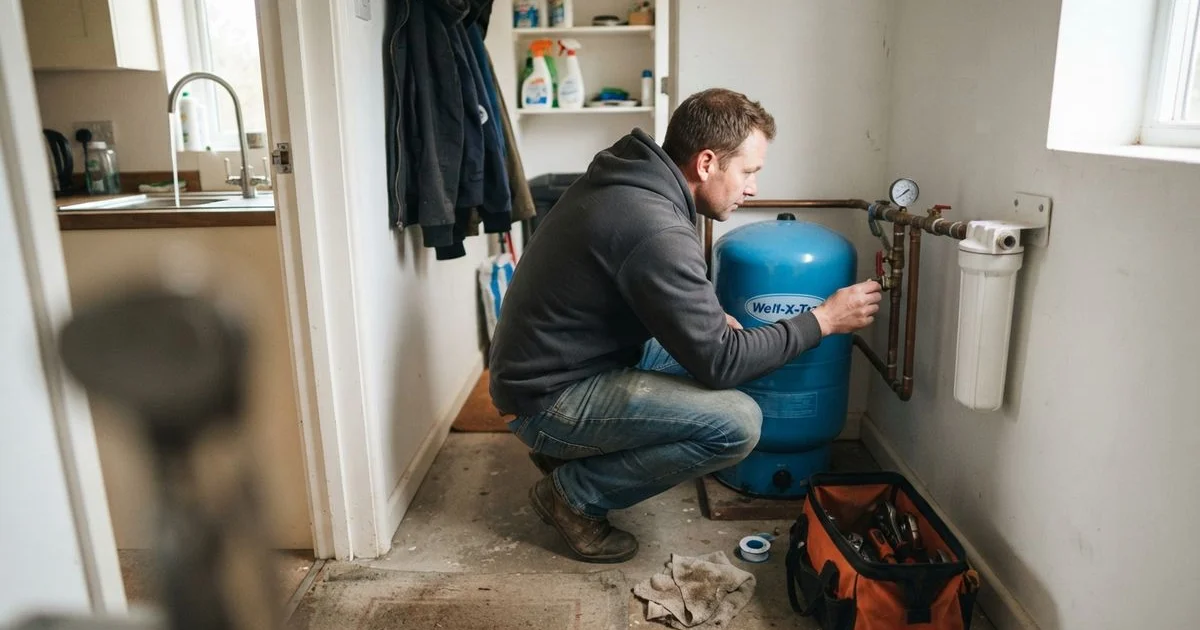
Stay on the safe side of the line. Anything that means opening an electrical box or working on the pump itself is a job for a professional.
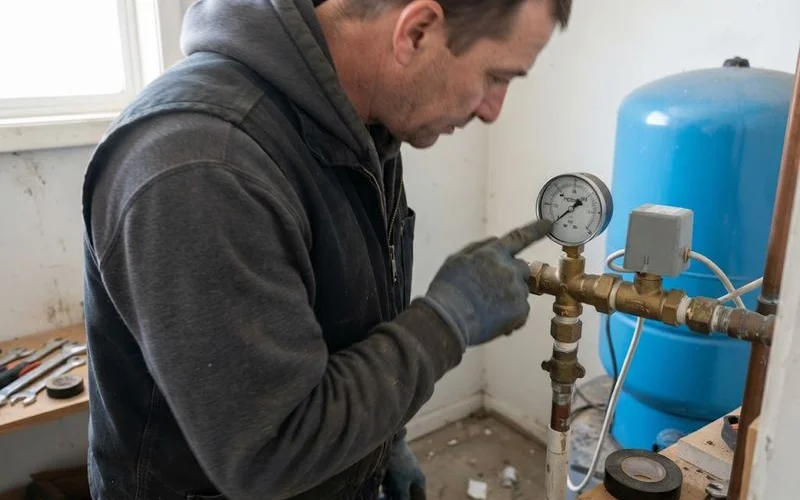
- Read the pressure gauge near the tank while someone runs water. Note the numbers where the pump turns on and off.
- Look at the whole-house filter. A clogged sediment filter can strangle flow. Swap it if it is overdue.
- Check for wet spots around the tank, along the line from the wellhead, and in crawl spaces.
- Compare hot and cold. If only hot water is weak, look at the water heater side before blaming the well.
- Listen. Humming without water, clicking, or a pump that never shuts off are details worth reporting.
Why the tank matters more than people expect
The pressure tank holds a cushion of compressed air that smooths out the pump’s work. When that cushion is gone, the tank cannot buffer anything, so the pump starts and stops constantly and pressure feels uneven. Many homeowners assume the pump has failed when the tank is the problem, and the reverse happens too. If the tank does turn out to be the culprit, the pressure tank replacement guide walks through what the visit involves. If you have an older tank, ask the technician to check it whenever they are out. You can see how local providers handle this work in our pressure tank and water system repair listings.
Seasonal and site factors in North Idaho
Dry late summers can lower water levels in some wells, which shows up as pressure that fades during heavy irrigation or laundry days. Cold snaps can freeze exposed lines or switches in unheated pump houses. Neither is guaranteed to be your cause, but mention the season when you call because it helps narrow things down.
When to stop troubleshooting
Call a provider if pressure is gone entirely, the pump runs nonstop, you hear grinding, the breaker keeps tripping, or the water turns cloudy or sandy. Do not reset a tripping breaker repeatedly. A short, specific description saves diagnostic time, which is a theme reviewers of local companies mention too: they say crews explain the problem clearly before starting work. That is their reported experience, and a useful standard to hold any company to.
If you want to see how we sort and describe providers, read our methodology, or head back to the home page to start a search.
FAQ
- Is low pressure always a bad pump?
- No. A clogged filter, a failing pressure switch, a tank that has lost its air charge or a leak in the line can all cause weak pressure while the pump itself is fine. Sorting out which one it is comes first.
- Can low pressure damage my pump?
- It can be a sign the pump is working harder or cycling more than it should, which adds wear. If pressure drops together with odd noises, frequent clicking or sputtering taps, get the system looked at sooner.
- Should I keep running the water while I wait for a repair?
- If the pump is struggling, heavy use may make it worse, and a pump running dry can be damaged. Limit use until someone has checked it.
- What should I tell the repair company?
- Describe when it happens, how long it has been going on, whether the pump runs constantly or cycles, and whether anything changed recently such as a power outage or a filter swap.